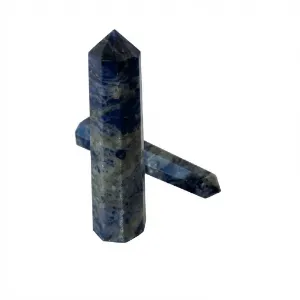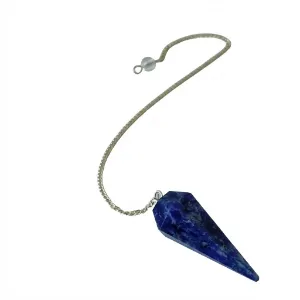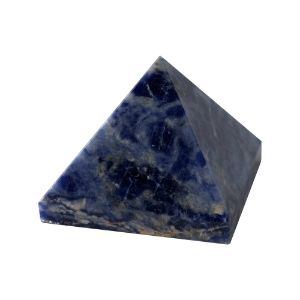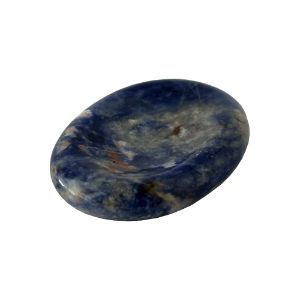
If you’ve ever been drawn to a rich, stormy blue stone threaded with white, chances are you were holding sodalite. It’s one of those crystals that pulls you in quietly, without the flashy gold flecks of lapis lazuli or the dramatic purple of amethyst. And that understated quality is kind of the whole point.
Sodalite has been called the Poet’s Stone, the stone of logic, and the crystal of truth. However you frame it, the common thread is the same: this is a stone that helps you think clearly, speak honestly, and find calm in the noise. If you’ve been feeling scattered, anxious, or stuck in your own head, sodalite is worth understanding.
Here’s everything you need to know about sodalite crystal meaning, its healing properties, and how to use it.
What Is Sodalite?
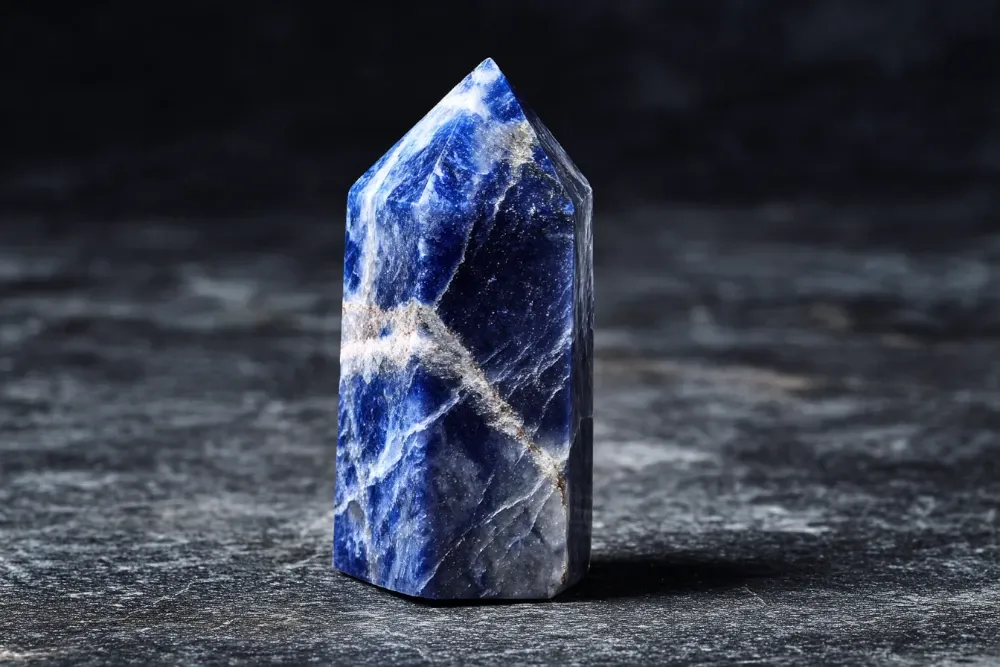
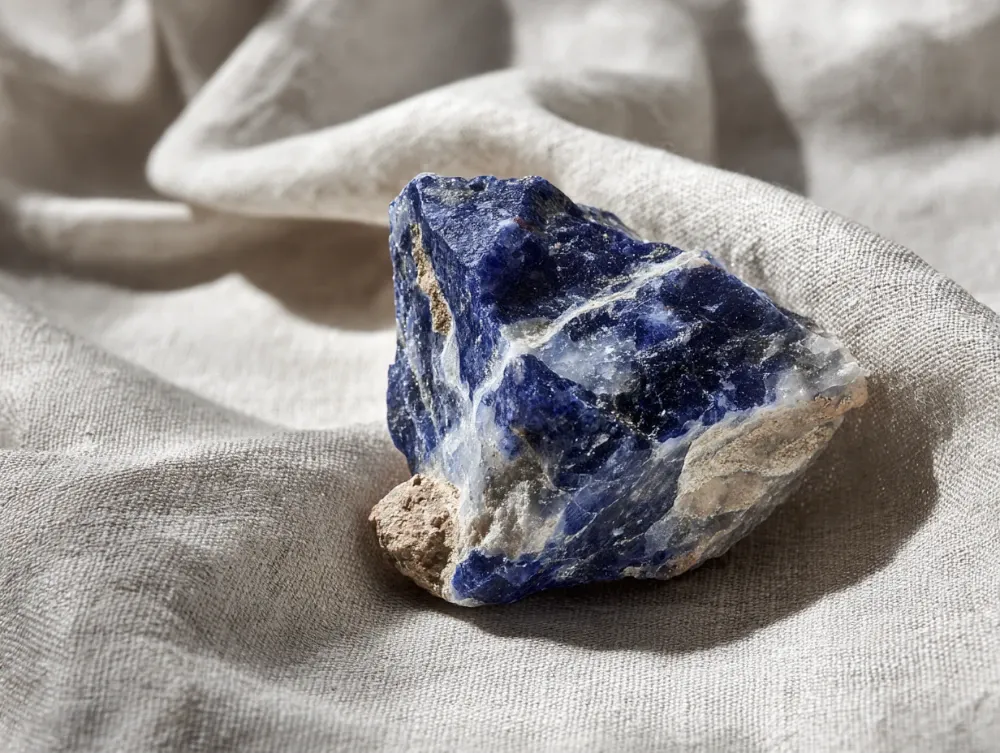
Sodalite is a deep blue tectosilicate mineral, typically appearing as a rich royal blue with white calcite veining running through it. Occasionally you’ll find it in grey, green, or lavender tones, but the blue varieties are by far the most sought-after.
It belongs to the feldspathoid mineral group, alongside hauyne, nosean, and lazurite. The name comes from its sodium content, fitting for a stone so associated with clear, grounded communication.
Sodalite was first identified by Europeans in Greenland in 1811, though historians have traced its use back to the Caral people of Peru's Supe Valley, who traded it as far back as 2600 B.C. Today the most significant deposits come from Brazil, Canada, Namibia, and parts of Russia and India.
Physically, sodalite is moderately hard at 5.5–6 on the Mohs scale, has a vitreous to slightly greasy luster when polished, and is almost always opaque. It’s frequently found intergrown with white calcite, which produces the characteristic veining most collectors recognize immediately.
Sodalite Crystal Meaning
At its core, sodalite crystal meaning is about the union of logic and intuition. It’s often described as a bridge stone, one that helps you connect what your mind knows with what your gut feels, and then communicate that clearly to the world.
The name itself comes from its sodium content, sodalite is one of the most sodium-rich minerals on Earth, but the way people describe working with it has always felt more personal than geological.
This is why sodalite has long been associated with writers, speakers, teachers, and anyone whose work depends on articulating ideas with precision and authenticity. The Poet’s Stone nickname isn’t just poetic, it reflects a real tradition of using sodalite to support creative and intellectual expression.
Sodalite Spiritual Meaning
On a spiritual level, sodalite is closely tied to the throat chakra and the third eye chakra. This dual connection is what makes it stand out from other communication stones.
The throat chakra governs how we express ourselves, our ability to speak our truth, articulate our thoughts, and be understood. When this energy center is blocked, you might feel like you can’t find the right words, hold back from saying what you really think, or struggle to assert yourself.
The third eye, meanwhile, governs perception, intuition, and inner knowing. Sodalite’s link to this chakra is why so many people use it during meditation, it’s said to quiet mental chatter, encourage honest self-reflection, and open a clearer channel to your own inner wisdom.
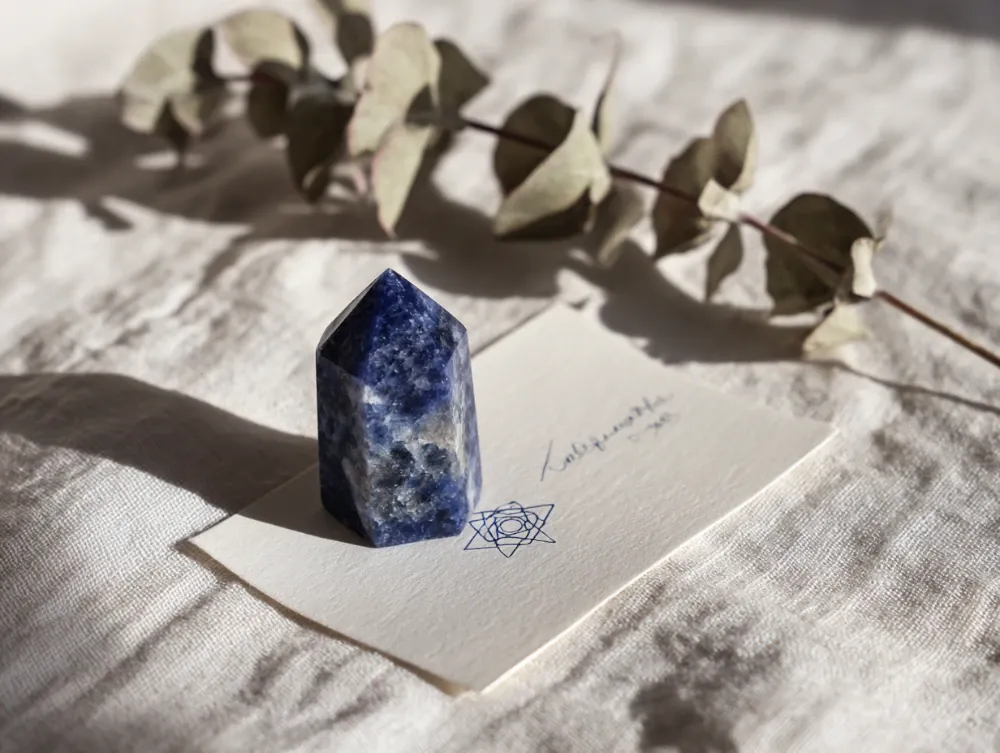
Together, these two associations paint a clear picture: sodalite helps you see clearly (third eye) and then express what you see (throat chakra). That’s a powerful combination if you’re working through self-doubt, creative blocks, or patterns of poor communication.
Sodalite Healing Properties
Emotional Healing
Sodalite is widely regarded as one of the better crystals for emotional balance and mental clarity. Its energy is cooling and calming rather than stimulating, which makes it particularly useful during moments of anxiety, overwhelm, or emotional reactivity.
Specifically, people work with sodalite to:
- Reduce anxiety and panic: Sodalite’s calming energy is said to soothe the nervous system and interrupt spiraling thoughts. It’s often recommended for those who experience frequent stress or emotional volatility.
- Release fear and guilt: Sodalite is considered a good stone for clearing out the heavier emotional residue, the self-doubt and shame that tend to accumulate and slow us down.
- Improve self-trust: One of the less-talked-about aspects of sodalite meaning is its connection to self-confidence, not the loud, outward kind, but the quieter trust in your own judgment and instincts.
- Stabilize mood swings: Its grounding quality can help anchor emotions that tend to swing between extremes, making it a useful companion during periods of transition or stress.
Mental and Intellectual Properties
Sodalite is one of the few crystals explicitly associated with logic and rational thinking, which makes it somewhat unique in the crystal world. Where many stones focus on emotional or spiritual healing, sodalite bridges both by bringing the mind into the conversation.
It’s said to enhance focus and concentration, help sort relevant information from noise, and support clear decision-making. If you’re someone who tends to overthink, running the same loops over and over without arriving at clarity, sodalite’s energy is often described as the thing that breaks the cycle and lets you settle into a conclusion.
This also makes it a useful stone for study, writing, research, or any mentally demanding creative work.
Physical Healing Properties
On a physical level, sodalite is traditionally associated with the throat, vocal cords, and upper respiratory system. Practitioners in crystal healing also link it to the immune system, metabolism, and blood pressure regulation, though as always, crystal work should complement, not replace, conventional medical care.
Its Mohs hardness of 5.5–6 makes it durable enough for regular wear, though it should be kept away from harder stones in your collection and stored in a soft pouch when not in use.
Sodalite Crystal Benefits
To bring everything together, here are the key sodalite crystal benefits people report when working with this stone:
- Communication and self-expression: This is sodalite’s most consistent association. Whether you’re a public speaker, a writer, someone working through relational conflict, or just trying to express yourself more honestly, sodalite is a natural ally for the throat chakra.
- Clarity and focus: Sodalite cuts through mental fog. It’s a good stone to keep on a desk, hold during planning or creative sessions, or meditate with when you need to think clearly.
- Emotional calm: Its cooling, steady energy helps interrupt anxiety and emotional reactivity without numbing you out. Think of it as a long, slow exhale for your nervous system.
- Self-awareness and honest introspection: Sodalite encourages you to look at yourself without the filter of ego or self-protection. That’s uncomfortable sometimes, but it’s the kind of honesty that leads to real growth.
- Creativity and inspiration: Especially for writers, musicians, and artists, sodalite has a long tradition as a stone that loosens up creative blocks and helps ideas move more freely from thought to expression.
How to Use Sodalite
Wearing Sodalite
Wearing sodalite as jewelry is one of the most effective ways to keep its energy consistently with you. Because it’s linked to the throat chakra, a sodalite necklace or pendant worn close to the throat is particularly intentional, but bracelets and rings work well too.
If you carry sodalite in your pocket or bag, you can take it out and hold it briefly whenever you feel anxious, overwhelmed, or about to enter a difficult conversation.
Meditating with Sodalite
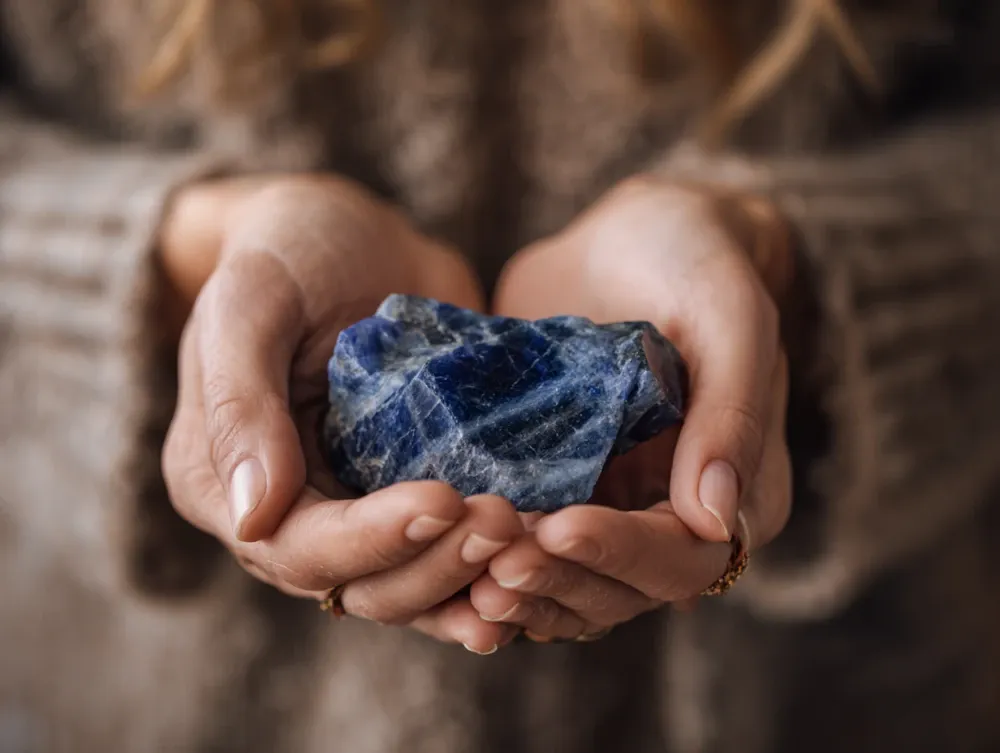
Hold sodalite in your hand or place it on your throat or third eye during meditation. Its energy is said to quiet internal chatter and support deeper, more focused inward states. If you do dream journaling or practice lucid dreaming, sodalite is also traditionally associated with clearer dream recall.
At Home and in Your Workspace
Placing sodalite in a home office or creative space is a popular choice. As a water element stone in Feng Shui, it brings emotional balance and clear communication energy into environments where those qualities matter, meeting rooms, studios, anywhere that benefits from calm focus and honest exchange.
Crystal Pairings
Sodalite pairs well with:
- Clear quartz, amplifies sodalite’s clarity and communication properties
- Rose quartz, combines emotional healing with sodalite’s self-awareness energy
- Lapis lazuli, both work the throat and third eye; together they deepen intuition and truthful insight
- Amethyst, another third eye stone; pairing the two supports calm, focused meditation
Cleansing and Charging
Because sodalite is porous and somewhat water-sensitive, cleanse it with a brief rinse under cool running water (don’t soak it) or by passing it through sage or palo santo smoke. Charge it overnight in moonlight or by resting it on a selenite plate for several hours. Avoid prolonged sunlight, as it can fade the stone’s color over time.
Sodalite vs Lapis Lazuli: What’s the Difference?
This is one of the most common questions about sodalite, and understandably so. The two stones look strikingly similar, especially when polished. Both are deep blue with white calcite veining, both are linked to the throat and third eye chakras, and both carry meaning around truth, communication, and inner wisdom.
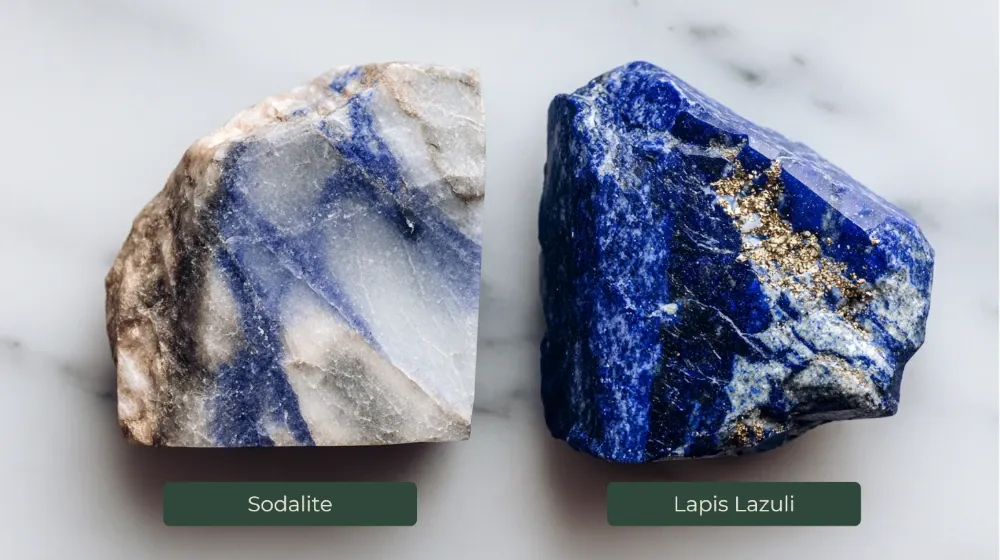
But they are distinct stones, and knowing the difference is useful whether you’re building a collection, buying jewelry, or choosing between them for a specific intention.
- Composition - Sodalite is a single mineral. Lapis lazuli is a rock made up of multiple minerals, primarily lazurite (which gives it color), along with calcite and pyrite. Interestingly, sodalite is actually one of the minerals that can appear within lapis lazuli.
- The pyrite test - The quickest visual tell: lapis lazuli often contains small golden flecks of pyrite. Sodalite does not. If you see gold sparkle in a blue stone, it’s likely lapis. That said, not all lapis contains visible pyrite, so absence of pyrite alone doesn’t confirm you have sodalite.
- Color tone - Lapis lazuli tends toward a richer, more saturated royal blue. Sodalite is often slightly cooler, darker, and more understated, sometimes leaning toward navy or indigo.
- UV fluorescence - A practical identification trick: under ultraviolet light, sodalite often glows orange or yellow. Lapis lazuli typically does not.
- Streak test - On a rough surface, sodalite leaves a white streak while lapis lazuli leaves a blue one, a reliable distinction when working with raw stones.
- Hardness - Sodalite scores 5.5–6 on the Mohs scale. Lapis ranges from 3–6.5, depending on its mineral composition. In practice, sodalite is slightly more resistant to scratching.
- Price - Because lapis lazuli is rarer and carries a much longer historical and cultural legacy, it tends to cost more. Sodalite offers comparable visual appeal and similar energetic properties at a more accessible price point.
Energetically, both stones work with the throat and third eye chakras, but practitioners tend to distinguish them this way: sodalite is the grounded, rational communicator, it brings calm logic and honest self-expression. Lapis lazuli is more associated with deep spiritual wisdom, transformation, and awakening. If you’re drawn to clarity and communication, sodalite is the natural fit. If you’re working with deeper spiritual inquiry, lapis lazuli may be the stronger choice, or use both together.
Is Sodalite Right for You?
Sodalite tends to resonate most with people who feel pulled between what they think and what they say, or who struggle to trust their own judgment. If you’re someone who second-guesses yourself, holds back in conversations, or finds that anxiety and mental noise get in the way of clear thinking, sodalite is a stone worth sitting with.
It’s also a natural fit for creatives, teachers, therapists, coaches, and anyone whose daily work involves finding the right words.
And if you simply love deep blue stones and want something that brings a calm, grounded quality to your space, sodalite is one of the most beautiful and accessible options in the crystal world.